Bored of the same old Irish Dance? Then you gotta watch this one performed and choreographed by Suzanne Cleary & Peter Harding.
(Thanks, Arun)
The new Kerala Tourism advt is the talk of the web now. The new video, created for an international tourism campaign, is exotic and sensuous. The whole presentation is different from the traditional ads about Kerala. The overused and cliched imagery of Kathakali is presented in a different way. And that same scene highlights the new strategy of Kerala Tousism of promoting rural tourism. Theyyam is featured and that scene is just amazing! The backwater scene sends out a message of finding oneself within the beauty of Kerala. The well-being element of Ayurveda is promptly highlighted. The grove scene is yet another breath-taking shot. Then it concludes beautifully with the final scene of wildlife with an Asian elephant.
I am not sure what is Kerala Tourism targeting with this advt though. If they are after the people in the west who have a mystical passion about Africa and want to get them here, I think they will succeed. This advertisement video, being as sensual and exotic it is, establishes itself as an alternative destination to Africa (is that why there are too many African elements in this movie including the music?). One thing I don’t understand is why they had to bring in a Senagalese singer to lend voice to this video that markets Kerala. They should have included some Kerala elements in the music. And the first scene doesn’t convey anything about the movie (Is that eerily looking human figure a ghost, an old man with a walking stick or a fisherman?). Okay, we know the place is Thekkady but since this is an international ad, I don’t think anybody would understand what this is about in the beginning scene of the video. Except for these couple of points, I loved this fresh new approach.
Shot at Thekkady, Munnar, Thalassery and Kannur in 11 days, this video is directed by Prakash Varma (of Vodafone Zoo-Zoo fame) and is produced by Stark Communications.
The only thing you need to do to understand how Mohan Lal represents a typical Malayali is to simply look at the brands or industries he endorse through advertisements. Here is a reference. Have a look. 🙂
1) At first, Mohan Lal asks us to buy gold from Malabar Gold, saying that we need an ‘eternal golden touch‘ to our precious moments in life. This represents the common Malayali obsession for gold.
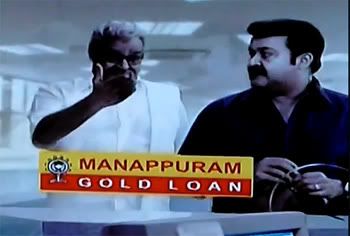
2) Then he goes on to ask “why keep gold in your house when you can cash it?” and advises to take gold loans from Manappuram Gold Loan. That’s what a typical ordinary Malayali does. Spend so much on luxuries and when he goes out of cash, get his wife’s/kid’s gold ornaments to take gold loan to spend it for further luxuries.
3) When gold and money go away, Mohan Lal asks us “what’s up this evening?” and gets us to drink Original Choice to forget everything. A typical Malayali finds solace (or gives that as a reason or his drinking habit) in liquor.
There is only one more advt that Mohan Lal needs to do to complete this Malayali representation. An agarbathi ad. He could just show the ‘son’ in the Manappuram Gold Loan ad being not able to take his gold back and runs out of cash by paying interest and decides to hang himself. When the ‘son’s’ dead body is laid down the agarbathi could be shown next to the deadbody with a tagline “everybody has got a reason to pray“!
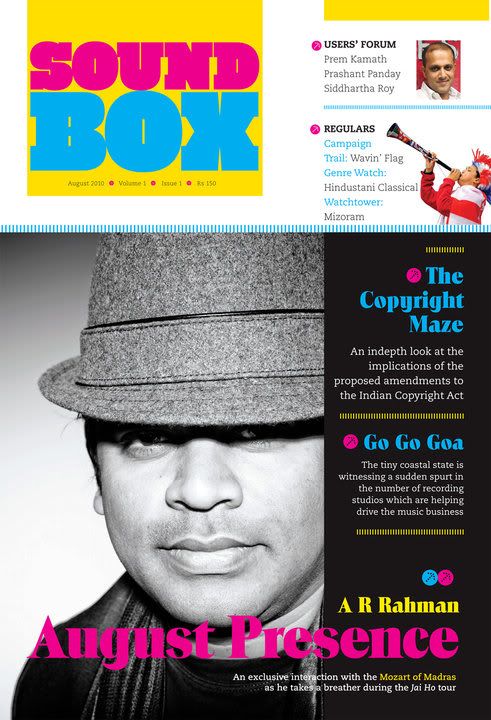
Though touted as a music trade magazine, I think Sound Box will be interesting to all kinds of people who love music. Their initial package looks very promising. They had a buzz section that covered latest Indie, digital, TV, radio, gadget news. The main feature was about the amendments to the copyright act and the responses of various personalities to the issue. It has an interesting interview with singer Sonu Nigam on the issue. The guide section gives it a more elaborate look on the music charts, local events calendar (which will need to expanded to southern Indian cities like Bangalore, Chennai etc).
One hopeful thing though is a section called “Watchtower” where they have featured a state and this time a north-eastern state – Mizoram. Sound Box has given an overview of the state’s music scene, covering everything about it – music culture, music channels, popular local talents, venues, music labels, studios etc. It also has an interview with Boomerang – the Junk Rock band from Mizoram. I hope this would eventually lead the mag to cover or explore all regional music scenes, including the southern states. Another interesting story from the inaugural issue is about a Tamil rap band from Dharavi.
I see a couple of drawbacks to the mag though. The price being the first one. Though the good people at Sound Box sent me a free copy, the magazine is priced at Rs. 150. I think that price is a bit high for an ordinary music lover. I don’t think I will spend anything more than Rs. 50 on a magazine and that could be achieved by making the poster sized pages thinner and by reducing the huge size of the mag. Size is the second thing – I wish they had a lesser size for the mag so that it would be easy to carry it along on journeys and would make a comfortable reading in public places.
Other than these two, I totally loved the mag and wouldn’t mind subscribing to it.

Title: You’re Hired! How to get that job and keep it too!
Author: Nasha Fitter
Publisher: Penguin
Price: 199
To begin with, my English is self-taught. I learned how to read, write and speak English through various media. TV, books, blogs (when it became popular), and movies to start with. I owe so much of it to movies, sub-titled DVDs in particular, for helping me get used to some phrases, different dialects and a bit of a pop-culture from the West. I had my dictionary (and later Internet) in hand to learn more. But I always lacked an authentic book or person to refer to whenever I had doubts about the language or it’s usage. Many people whom I thought would be helpful were not so. Main reason is the basic human ego. Not everyone knows everything but people most of the times are not ready to admit their mistakes. And worse, they would pass on their mistakes to others pretending that they were right even when they were unsure. So it was high time that I found one useful reference.
Then came Pai, my ex-colleague and friend. He knew where I came from because we had some parallels between us. One fine day, Pai told me about a book he had read. He said it would help even people who thought they spoke/wrote good English. Written by Nasha Fitter, the book is titled “You’re Hired! How to get that job and keep it too” and I must say for a guy like me, it was the most useful book I read in the recent times.
The book in one word is – amazing! It is specifically written for people of India, particularly for youngsters who are looking for jobs (I would say the target includes people who are already working their jobs) in the IT and ITES field who make a lot of common (in India) errors when they speak or write English. Nasha Fitter’s several years of experience in training people in India lead to this book. It has several excercises at the end of every chapter (with an answer key section) which makes it fun to learn. And thankfully, the grammar is explained very simply and there is no shakespear quotes. Examples included only the daily conversations. I wish our school textbooks on English had the same simple format; it would have made grammar lessons look less scary.
I have to shamefully admit that before I read this book, I thought the plural of mouse is “mouses” instead of mice. I never understood why there are two words like “foot” and “feet”, or “tooth” and “teeth”. I never knew “do the needful”, “concerned person”, “will intimate you” are all wrong usages and “living” and “staying” have different meaning. The book even has a chapter that explains “Indianisms” which includes common errors we make. It also has tips to help you prepare for interviews.
I found this book extremely useful and I’m sure everybody like me would feel the same when they read this book. I’m going to re-read this in regular intervals to keep me learning. Priced at Rs. 199, this is a perfect buy. The target audience of this book is not people who don’t speak/write English but people who think they know enough English to speak or write and that includes me. 🙂
When Mammootty and Kamal Hassan, two actors from the South have got 3 national awards each, how could Hindi cinema, the so-called Bollywood, afford not to be on par with them? Especially when they are marketing themselves as Indian cinema? (I mentioned the “southern” factor specifically because the media always highlights it to distinguish them from the rest of India, like this IBNLive article says “southern music mastero Ilaiyaraja“. A R Rahman is lucky to have been adopted by Bollywood, so he doesn’t have to bear that “Southern” label when he is mentioned in the reports).
So this time when the National Film Awards were announced, we learned that the Best Actor award went to Amitabh Bachan for “Paa” and the close competitor for the title was Mammootty for his performances in Kutty Srank, Palerimanikyam and Pazhassi Raja. And many people believe that this time, again, the award jury made an unjust decision. They say that the award should have gone to Mammootty and not to Amitabh Bachan.
If I was in the jury, I would rule out Mammootty’s role in Pazhassi Raja, because the actor did not have much to do in that film as an actor. It was the film as a whole that stole the show entirely. The film was a blend of so many amazing talents on many fronts and Mammootty was just one of them. I believe he did not have much to do in that film as an actor. I haven’t seen Kutty Sraank, so I would not comment on that. But various reviews have praised Mammootty’s acting in that film to the core. I have seen Paleri Manikyam and the way Mammootty mastered the role of Kunjahammed Haji was just amazing.
I have seen Paa too. Comparing to himself, Amitabh Bachan was awesome. Auro was perhaps the best character he has ever got in his acting career. So I would rate him coming to a close second in the competition but not above Mammootty’s Haji in the race for the best actor.
For one thing, like most of the sentimental, teary-eyed Indian movies, Paa lacked the cinematic maturity of treating a subject like this. It purely banked upon the melodramatic overtones and it’s father-son “star” cast. Bachan’s make-up did not even let you see his face, leave alone the facial expression. Many people argue that his body language was perfect for the character, and I would agree with that, but the body mannerisms alone should not have brought him that award. Mammooty had different mannerisms in Paleri Manikyam too. He had to put on different facial expressions, body mannerisms and even different dialects to work with in that film and he had succeeded in all that. I hear that in Kutty Sraank also he had the same or bigger challenges.
This is not the first time that the national award jury snubbed the Malayali actors for Amitabh Bachan. When Bachan got an award for playing typical Bachan in Agneepath, the person who left out was one of the best actors ever happened to Malayalam cinema – Thilakan – for an unforgettable role he portrayed in the script of MT – Perumthachan. And now, Mammootty.
I don’t understand the criteria put forward by the jury. Is this a sign that such award juries have not come of age? If an actor does a sympathetic character with lots of scope for raining tear drops and an imported make-up man, would that be enough to actually get him an award?

Swarnalatha, an awesome singer whose unique voice kept us mesmerizing throughout her singing career (how can I ever forget the sad version of “Poraale ponnu thaayi” from the movie Karuthamma”?), has left this world. She will live through her songs. Rest in peace, dear singer…
I have never read such a sharp, spot-on critic review in the recent times. Here is Sadanand Menon’s take on A R Rahman’s Commonwealth anthem, published in Outlook (reproducing it in full here).
RAHMAN’S ‘ANTHEM’ ADHYAAY
Anthems are devised to make your spirit soar. When they crash-land, they can also leave you sore. For some time now A.R.Rahman has been on song. This time the song is on him. His Jiyo, Utho, Badho, Jeeto takes all of 4 minutes and 16 seconds to expose you to the perils of skydiving without a parachute. But then, this is the anthem for the 2010 Commonwealth Games and, like many other things connected with this year’s CWG, it is just another kind of cruel sport.
The idea of an anthem for sporting events is arguably to foreground a consistent theme as a focal point of the event and to unify the audiences with the adhesive of a familiar, infectious rhythm. In the present context of a Games mired in debilitating controversy and hint of sleaze, a rousing anthem could have been a talisman to unlock some positive energy.
But the present offering of India’s own Mozart, launched with much fanfare on August 23, has left even the Group of Ministers unhappy. That must be the ultimate ignominy – that aesthetic cynicism of such crass proportions can even affect the GoM. Though, one suspects, it was not so much the notations on the music sheet but the notations on the bill that did the damage.
Even as Oscar-hero Rahman was concatenating, at super-speed, his CWG jingle that jangles with some of the most pedestrian verses in recent times, he also fed into the computation a punchy figure of some Rs.1.37 crores for every minute of the song. Total, Rs.5.50 crores.
In 2006, for the inaugural functions of the Frankfurt Book Fair where India was the ‘Guest of Honour Country’, a proposal by music composer Ilayaraja to present a Carnatic raga using a 120-piece Western philharmonic orchestra, was summarily rejected because of the price tag of Rs.95 lakhs attached to it. But times have changed.
The funny thing about Rahman’s Swagatham number this time is that after its recitative first part – with lines as stiff and strangulating as ‘Junoon se, kanoon se, maidaan maar lo’ – the second performative segment breaks into a beat that sounds like a rip-off of his own composition Ramta Jogi in the film Taal. Obviously Rahman is now famous enough to plagiarize himself and even charge us for it. But the obvious question that needs to be asked is why did he even try? Why did he not simply offer back the same Ramta Jogi(Playboy Ascetic) as the anthem for the Games? The song has all the right foot-tapping ingredients, including oblique references to playful charlatans that would have blended well with the CWG.
Of course, Rahman’s anthem cannot be disconnected with the overall plan for inaugural and closing ceremonies of the Games. The fancy committee for the inaugural events has for a few months now been grappling with the logistics of how to present India in this highly televised event. It is a committee in search of a spectacle. The spectacle of a fake, make-believe India populated with Bollywood dancers and swirling silks, crooning divas and simpering starlets. Last time around, they were thinking of making a sound-and-light show with ‘Om’.
It is an India that has no specific location on this planet and is far removed from not just the lives but even the fantasies of its people. This is an India that is the pet project of its robber-barons who are enabled, each time, to whisk away some more resources in the name of an abstract nation.
That the vulgar Rs.380 crore budget for the opening ceremonies could not set aside a few crores for a group of poets in different languages to write an appropriate song for the opening anthem tells its own story of gross disinterest even in the context of the indefensible. Instead we have some utterly filmy gibberish like:
Uthi re ab iraadon mein tapan / Chali re gori, chali ban tthan.
The lines, as much as the composition, are stolen from some other context. As we believe are the Games.

I saw this photo on this year’s Janmashtami day in Google Buzz. I don’t know who clicked this but it is such a moving image. Many people say that there is nothing special about it as this is a common sight in some places in Kerala for Muslims to get their kids dressed as Krishna and make them take part in Shobhaa Yaatra on Janmashtami day.
I wonder what those hate mongers would think seeing this beautiful picture.
 The first thing I do after buying a book is smelling it. Every single book has a different smell. Some reminds me of the textbooks from school, some of the old notebooks or newspapers. The journalist blogger Annie Zaidi‘s book titled “Known Turf” smelled good too, except that afterward it was a tough journey to an unknown turf. As I skipped through the first chapter, I initially found it dragging and was beginning to wonder how writers like Sainath recommended this book as “a beautifully written book“. I was quite bored of her continued references to the Bollywood movie “Dushman” and her story of Tea. But it could be me and little did I know that I was in for surprises.
The first chapter has the title “Please do not carry loaded guns in the bus” and I was surprised to read that it was not a sign in the United States, but in Madhya Pradesh (in India where we blame Americans for their gun culture). I did not know that the people who have a BPL card are entitled to a health card that assures free medical treatment upto Rs. 20000 and just like me, most of the villagers who have a BPL card haven’t heard of this facility. At every single instance, we are ashamed and angry about people who portray India as a poor country but I read stories of famine in this book with not so much shock. I read that in Madhya Pradesh, 72% of children of Sahariya tribe under six are malnourished and within the first year of birth all that those babies are eating is dry roti. Even before they have grown teeth to chew.
I read stories of pregnant women chew bits of gum plucked off gum trees trying to kill hunger pangs. In Annie’s own words, “about women who have not eaten for three days giving birth alone in dark hovels, knowing their breasts are dry. About the dismissive assistant in the nutritional rehabilitation center who said that Sahariya women hardly deserve the state’s help because they smoke beedis.” Then the cover-ups of hunger index.
I also read the inside story of Punjab, which we thought of as the most prosperous states in India. Where the minimum wage is Rs. 96 per day. Where most people get between Rs. 40 and 80. I was thinking about all those urban friends of mine who blame Kerala for the state which we are in. Those friends of mine who sweats out themselves in Bangalore IT sector and always put blame on the state. Here, the minimum wage that a mason gets, compared to the minimum wage of the state of Punjab which is celebrated as a prosperous state in India, is Rs. 300-350 per day. And they call us an undeveloped, Communist state. I read stories of how Punjab’s Dalits are tortured. Of the Zamindars who formed a committee and announced a boycott of all laborers who wanted higher wages. How the Zamindari and Dalit politics constructs Punjab’s social fabric. I realized that Punjab ain’t those beautiful wheat fields that some Hindi movies show case.
Annie also writes about Sufism and her affinity to it. But from what I read about the Sufi practices I don’t understand how it is different from the core principles of other religions or religious sects because Sufism also promotes the Master-Slave concept. Why the heck is God always seen as a Master and never a friend?? She puts one thing right here though – that “whenever there’s a wider economic crunch, or when there’s personal frustration and insecurity, either there’s revolution or people turn to spiritualism.”
Annie’s book gives an in-depth analysis and real life stories of power, crime, poverty, caste-politics, corrupt bureaucracy, religion, labor bondage and feminism – be it the stories of dacoits from Chambal or the poor weavers of Uttar Pradesh. These are not the kind of stories you would find in your daily newspapers. These are the stories which would shake you for good and make you think about all the shining glory that we boast upon about India and some of it’s states. It give you a pointer to the unknown turf that lie buried in India’s underbelly.
If you care about it, I would recommend you read this book.
Title: Known Turf
Author: Annie Zaidi
Publisher: Tranquebar
Price: Rs. 250