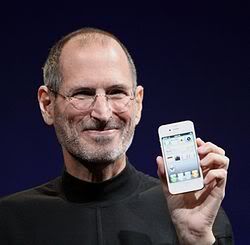
 “daa, did you read the newspaper today?“, I heard my mother asking. “Yes, why?” “Who is this Steve Jobs? What did he do?” The Malayalam daily had carried the headline of Steve Jobs’s demise and my mother was wondering how come this name that she had never heard of before occupies the prime space of the local newspaper. She was even more curious to read that this man was the founder of ‘Apple’. When I heard this innocent, curious question from my mom, I thought, what do all these obituaries praising Steve Jobs as a man who has made a difference in the everyday life of people really mean to a country like India and it’s people?
Until the recent past, Steve Jobs (or Mac) was a name or rather some sort of elite, exclusive knowledge for the techies in India that they would occassionally use to exhibit their knowledge of the world of computers. It is like when a group of people talks about Micheal Jackson and then someone in the group tells them, “MJ is crap, you should hear < the-name-the-majority-of-people-in-the-group-has-never-heard-of >” and rest of the group would think, “wow, this guy must know a great deal of western music“. Ironically, this elite exclusivity (and I am speaking from an Indian context) is also the core of the line of products that made Steve Jobs popular.
I had not seen a Mac machine until I stepped into the studio of Chetana Film Academy in Thrissur. Mac, in those days, was the most expensive computer I had heard of. Someone told me that the Mac I saw in the studio, even the low-end ones, was prized at around one lakh Indian rupees. Then came iPod that had many models to choose from according to your budget. The music experience of iPod was of course good, but I don’t know what special did iPod do in a market of MP3 players that Sony’s Walkman did not do in a market of audio cassette players (and I like the audio quality of Microsoft’s Zune compared to iPod but that product seems to have failed miserably). Then the iPhone, that forces you to choose a cellular operator of Apple’s choice (speaking legally, I’m aware of the ‘unlock option’), and the version 4 costs about 45,000 Indian rupees. iPad followed shortly after which is yet another upper middle-class toy.
So what significance does Steve Jobs have in a country like India? Is it for those fancy gadgets that has not made any change in the life of people here except, of course, for the business class and upper middle-class? No. It is his journey of life that stays inspirational to many people. The story of an adopted kid, the college drop-out who followed his dream to become one of the most famous and successful entrepreneurs in the world. The man who stayed hungry and foolish. It is for his life that he will be remembered best.
As for me, other than his life story, I thank him for Pixar that continues to give us the best animated feature films of our times.