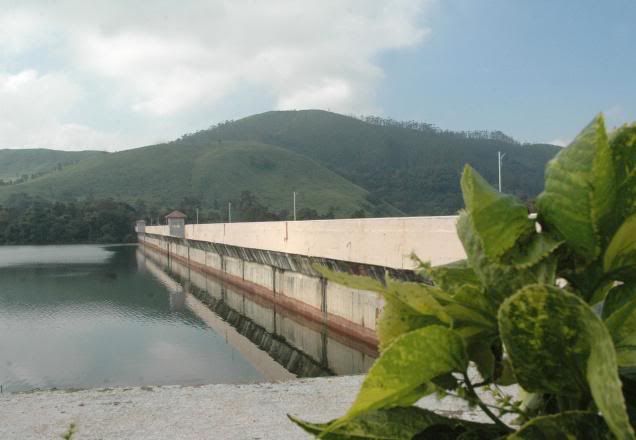
To control or not to control, that is the question!

Every single Malayali is now concerned about Mullaperiyar dam all in a sudden, though the dam has been in (alleged) danger for many years. The proposition from the Keralam side is to lower the water level, decommission the existing dam and build a new one. Why? Because Keralam fears that the dam cannot take a major earthquake and it could cost the lives of people in four districts of Kerala. But the process of building a new dam will take a few years and it remains unclear what guarantee the government will provide that an earthquake during this time will not happen or will not effect the people living in the surrounding towns. Which leads to the question, is the dam really in danger? If so, are the measures being proposed now enough to take care of the threat? Or are there any other motives behind the Keralam proposition? Keralam has also made a ‘generous’ offer to build a new dam at it’s own cost and still provide water to Tamil Nadu (which will transfer the control of the ownership, operation and maintenance of the new dam and it’s surrounding areas from Tamil Nadu to Keralam).

On the other hand, Tamil Nadu claims that the dam is in good shape and it can live longer. World over people are talking about decommissioning dams older than 40-50 years but Tamil Nadu politicians believe that it is not yet time for this 116 year old dam, built with limestone and surki, to rest in pieces. Commonsense would tell us that if not now, a new dam will have to be built sooner or later because this already 116 yrs old dam cannot survive the 999 years of the lease period. Tamil Nadu says that the safety of dam is an important matter to them also, because a burst of dam would affect the irrigation, agriculture and the lives of Tamilians. They also fear that if the new dam and it’s ownership is transferred to Keralam, they may not provide water to them.

But what does the common man learn from the whole issue? Ultimately, the issue of Mullaperiyar is not really about water or the dam’s safety but the ownership of the land. Currently, the ownership of the dam and it’s surroundings belong to the public works department of Tamil Nadu government though the area is in Kerala. Keralam had a good chance to claim it’s ownership of the dam and it’s surroundings when the lease agreement was renewed in 1970. We also had a chance to demand timely revisions of tax/lease rates per acre that Tamil Nadu has to pay. But the short-sightedness, or short-term interests of the government and officials in Keralam back then resulted in the current situation. It is only ourselves (or our politicians) to blame than the neighbor.

So what resolutions can be made now? A political resolution is most unlikely to turn out to be in favor of Keralam because Tamil Nadu has better political negotiation power in the center. Even though Keralam has a couple of Congress ministers in the center, it will be stupid to expect the UPA government to intervene against the interests of both Karunanidhi and Jayalalitha as regional political parties play a big role in the coalition politics in India. If safety is the concern, Keralam should wait for the report of five-member committee appointed by Supreme Court and act accordingly. Meanwhile, we should take measures to handle an emergency situation in the area. If the water supply is the concern to Tamil Nadu, they should ensure the supply through a legal pact with Keralam while making sure of the safety of people and timely decommissioning of the dam. Or if ownership is the real issue behind all this, both states should make it clear and file their claims in the court.

Right now, it doesn’t seem both sides are being honest in their stance.

(Photo courtesy: The Hindu)
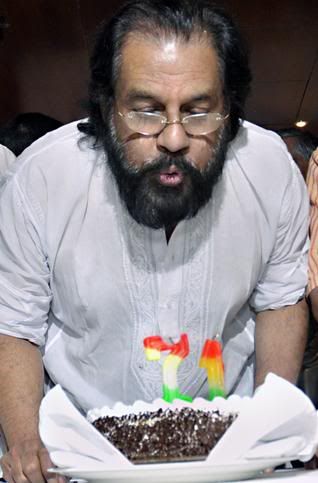
Yesudas – fifty years on

Do you remember the first time when you heard Yesudas’s voice? Probably don’t. If you ask me, I would say it is as difficult a question as asking when was the first time you heard your mother’s voice. It is said that not a day passes in a Malayali’s life without listening to this legendary singer’s voice. And now, the man has marked fifty years in the playback singing profession.

Yesudas is the ultimate benchmark for Malayalees when it comes to singing. “You sing like Yesudas!” was the ultimate compliment that a singer could get in the old days. In my childhood, the quality of singing was always measured by comparing a singer’s voice to Yesudas’s. So anybody who had a melodious voice would be fondly called “Junior Yesudas” in the local circle and that’s the biggest appreciation one could get in his local community. This has negatively affected singers who had a different tonal quality (not all good singers need to have a sweet voice and not all songs demand a sweet voice to render them).

As time has passed and people got exposed to various singers and genres of music, the benchmark was changed. Now, at least in the musician circles, having a voice that resembles or ‘accused’ to be resembling Yesudas’ voice is a curse. During my visit to Chennai, I had given a demo CD to a person in the industry on a suggestion from a friend. This person then gave it to a couple of music directors and then later told me that ‘they don’t need yet another Yesudas’. I realized how times have changed from my childhood, when everybody wanted to sing like Yesudas to this incident. From then onwards, the process was to cast-out the Yesudas influence. So I’d be more careful not to sound like Yesudas and would be disappointed and defend myself if I got a comment that said, “you sound like Yesudas!”, even if it is in a positive nature.

Yesudas has a contrasting life story. He was born in a poor Latin Catholic (kind of a Dalit in the Kerala Christian caste-ism) family and was taught music by a Tamil Brahmin. He is still not allowed to enter Guruvayoor temple because he was born Christian, but his song “Harivaraasanam” is played in the Sabarimala temple everyday before the sanctrum sanctorum is closed for the day. The Christian church has not disowned him, probably because of his popularity, even in the old days when a Christian would be expelled from the religion if he went to Sabarimala by following the penance and rituals. He has sung in several Indian and foreign languages, even though the perfection of his diction in languages other than Malayalam and Tamil are debatable. Purists of Karnatik music would say he has too much filmized the classical music, but he could help generate an interest in classical music among the laymen with his semi-classical filmy songs. He had made news when he allegedly said that Lata Mangeshkar should stop singing whereas he continues to sing in his 70s which has begun to draw criticism from some quarters.

For an ordinary Malayalee, Yesudas is not just a singer but an angel who advocates for peace. Somebody who transcends the borders of religion. And there is a saintly aura that was built around him in all these fifty years. And no ordinary Malayalee can tolerate any criticism against him.

One could very well doubt if this saintly, secular image was carefully tailored by the man himself. Though he has often commented on sociopolitical issues, he’s always been careful to sound neutral. When he spoke against something, particularly where the religious extremism is involved, he has never specifically spoken against anybody or any organization. He would pass on general/neutral comments which would give him a round of applause generally from all quarters. Most of the times, this is in the name of harmony and peace but it is debatable if it is part of an image that he is trying to maintain.

No matter how his sociopolitical comments are taken, there are many things that a singer could learn from the man. His hard work that started from the days of live recording, when there was no punch-in softwares available, and his devotion to music that he sacrifices some of the earthly pleasures for music.

At 71, Yesudas is not much of a wanted name in the Malayalam film music industry. With a wide variety of choice of singers and exposure to other language music and genres, Malayalees have learned to live past Yesudas. Perhaps this would be the right time for the singer to do what he had advised Lata Mangeshkar sometimes back. To stop singing filmy songs and dedicate full time to classical music. Nevertheless, Yesudas will continue to remain an icon in the Malayali community as long as he goes with the popular ideals of the society.

(Photo courtesy: The Hindu)

The Malayali Mob

When they hear about a group of people beating someone to death for petty crimes, Malayalees would take pride that it did not happen in their home state. ‘Must be Bihar‘, they would say. ‘Or some other illiterate state in India‘, they would comment. But when they got a chance, they proved themselves to be the most hypocritical society in India. And note that the victim here was not a thief, but a complete innocent.

Raghu, a native of Palakkad, was traveling to Perumbavoor in a bus with some money that he borrowed from gold loan. That is when two people got into a fight with him and started beating him. When people had noticed, they accused Raghu of pick-pocketing. It is only when Raghu got sick of the beating and fell down on the ground that the KSRTC employees kept the two culprits in their custody and informed the police. But Raghu had died before the police could reach the taluk hospital with him.

One one hand there is Raghu, a father of two, who took a gold loan of Rs. 19,000 from the local co-operative bank to help his wife’s grandmother’s family in Tamil Nadu. On the other, there are two people – one of them a gunman, a cop, to a Member of Parliament (K Sudhakaran) which gives him ‘special privileges’. Then there is police, who refused to give details of the questioning of the culprits and prevented the media from taking photos of them. They said it was an ‘order from the top’.

Then there is me and you – the Malayali common men who seems to believe that beating someone to death is justified if the victim is a pick-pocket. That is probably why nobody stopped the two culprits – the gunman and his friend – when they said the money that Raghu carrying was pick-pocketed. It is the same Malayali mindset that would justify the men who slapped a woman for traveling with a friend at night with a comment that ‘she deserved it‘, because she was traveling with her friend to drop her at her place after a night shift job. The same Malayali men who would justify the flesh trade pimping minor girls with a comment ‘why did that girl go with that man in the first place?‘, ‘she must have been craving for sex‘.

I think more than these people who abuse their power and positions, it is on us to take the blame. For being the silent spectators that we have turned out to be.

Da Vincing Code

The socio-political spectrum of Kerala always has something to entertain the average Malayalee. Be it V S Achuthanandan on one hand or P C George on the other. But who wouldn’t get bored of the same circus you see everyday? So now it is the turn of V R Krishna Iyer and his committee of people who have drafted the Women’s Code Bill 2011 which is pending approval of the state government.

The proposed bill suggests provisions to imprison those who fathers more than two children. So if this bill is passed, you will be slapped with a Rs. 10,000 fine or three months of imprisonment when you expect a third child in the family. Not only that, those who have three children would be considered as legally disqualified and they cannot enjoy the state benefits.

Needless to say that these suggestions are draconian. To have two or more children should be left to the parents and to intervene in those basic human rights and to add penalty to it is fascist. We are not living in China, after all. What the government should do instead of passing this bill to raise awareness of the advantages of population control. Kerala anyway has the lowest rate of population growth in India.

The protests have begun and as expected from the minority communities. The Christian and Muslim communities entertain having more children among their flock. The Church had announced ‘benefits’ for it’s community members who have more than four children. What these religious communities are aiming with this is an increased community power and thus the socio-political bargaining power in the future. But the proposed bill puts a stop to this as one of the recommendations of the bill is that religious and political outfits cannot discourage family planning and I think that is a welcome suggestion.

Population control is a need of the hour for a dense country like India though the decision of having more or less children should rest with the parents. To discourage it in the name of religion or community is going against the country’s well being and future. And to offer benefits only to those who have four or more children is as draconian as lifting the benefits off people who have more than two children. So it doesn’t really make sense to see the opposition from the Church and Muslim community heads.

Another sensible proposition in the bill is to offer free and healthy abortions in government hospitals. Abortion is another area that the religious organizations, who usually cite moral reasons to oppose it, should back off. Legalizing and providing expert help for abortions would help save some lives that usually gets lost by consulting with illegal clinics and doctors. Those who want to do abortions would go ahead and do it regardless of the law or their religion allows them to do it, so why not let them have it safely with expert help?

So there are some pros and cons in this bill and I wish the pro points stayed and cons removed. But with the protest from religious/community heads it is likely that the Chandy government would scrap it altogether.


The state of music retailers

[This was first appeared in Soundbox, September issue, as part of the cover story by Anita Iyer on the future of physical music retail in India]

The music retailers in the south-Indian city of Thrissur are on the verge of losing their business to the greater threat of Internet piracy. Some of the small players in the business have already shut down their shops for good and the remaining retailers are struggling for business. Now there are only two large music stores in the city, if you ignore a couple of small stores, and the grapevine has it that one of them are planning to shut their business down soon. But how is it possible that a small south-Indian city music business is affected by Internet piracy? We are not living in a country like UK where 83% of the population are online. According to World Bank’s development indicators, we have only 5.3% of our population using Internet. So what could have lead to this situation?
Blame it on the mobile phones. Now everybody has one and they use it extensively to play music than making and receiving calls. Youth, regardless of the economic class they belong to, are addicted to playing music on their cell phones. From the school/college students to manual laborers working on a construction site, music plays in the background. But where do they get these MP3 files from? If you take a look at the students, they know how to access and download the latest film songs from websites. But even they are not willing to spend time browsing on Internet for MP3 songs. They know an easy way – bring their mobile phone to the nearest mobile phone selling and servicing shop, give them a phone memory card and get the latest songs copied after erasing the old ones. The mobile shop charges a small fee but you get the songs you want for a much cheaper price than buying an authentic CD from a music shop.

Mobile phone shops and Internet cafes run this as a side business. All you have to take with you is a phone memory card, USB thumb drive or a blank CD. CDs are fast disappearing and it is the memory card that the youth prefers and USB storage drives that businesses and vehicle owners prefer to go with.

Then what is left for the retailers? Gone are the days of music fans who would line up to buy an A R Rahman album on it’s release date. One of the music shops in Thrissur, Melody Corner, has introduced an ATM (ATM stands for ‘Any Time Music’ here) where people can choose from a collection of 1.5 lakh songs and copy the chosen songs to a CD. But they cannot compete with the price that the mobile/Internet shops offer because the latter gets songs off piracy websites for free.

A large portion of music stores is now dedicated to movies. The loyal buyers of music seem to be those who have a genuine interest in a wide variety of music – like western/eastern instrumental, classical music, ghazals, devotionals, world music and old Hindi/Malayalam song collections of a particular singer or composer. Can music retail business in small cities survive with this small group is the remaining question.

Jagathy vs. Ranjini – What’s missing in the debate

There has been so much fuss about veteran Malayalam actor Jagathy Sreekumar’s mockery of reality show anchor Ranjini Haridas on the grand finale stage of Munch Star Singer. The majority of the people who cheered Jagathy were Malayalee men, with a few exceptions from some ‘progressive quarters’, but both the “for” and “against” arguments have missed some valid points that Jagathy had raised. But let me clearly state that I don’t fully condone Jagathy’s ‘show’. There are a few things that I did not like about the way he spoke. But I totally agree with the core point of his speech, on which I will comment later in this post.

One thing I liked about the beginning of his speech was that Jagathy had congratulated the judges of the show for all the right reasons. He mentioned that compared to the judges of other reality shows, the judges of Munch Star Singer (singers Venugopal and Sujatha) were patient to correct the kids, without making fun of them to entertain the audience/viewers. Here, we know which show and to whom he was referring to. I haven’t seen any other popular celebrities speaking up against this on TV or in public except Yesudas (who once made a mockery of, whom I would call, “the Sangathy man”). But that is obvious, no Malayalee celebrity would want to offend one of the most popular TV channels in Malayalam. They would be risking some prime time TV appearance by this. So I think it takes some courage on  Jagathy’s part to say this.

Then the mockery happened. What I didn’t like about that part was that Jagathy could have conveyed what he wanted to say in a better manner, without insulting the anchor who was standing next to him on stage. It is probably the Malayali male ego and jealousy of women who speak English, I guess. And it could be the same reason that the video of Jagathy’s speech is spreading across YouTube. Part of his speech was also taking a chunk of allowed time to elaborate on what would get him some claps. He also didn’t have to unnecessarily drag actor Jayaram into the issue. He could have spoken for himself.

But the main point that he raised in his speech is valid. Jagathy said that the anchors do not have the right to pass judgement on the singing/performance of the participants (and I assume that he did not mean to avoid encouraging/supportive comments). He said that is a bad practice and anchors should do just their job, of presenting the show well, rather than passing judgement. Evidently, he aimed at Ranjini Haridas and he is right at that too. This is what some of the opposing voices against Jagathy, feminists and ‘progressive people’ alike, fail to see.

Ranjini Haridas is as bad an example for an anchor. She has made unwarranted comments on the participants and their talent. In some cases, this has reached an abusive level. Read this post from Insight Young Voices.

The following is from a 2008 segment of the show. The compere, Ranjini Haridas is admonishing the ill-fated singer Somadas who had just delivered a supposedly miserable performance in the classical music round:

“The judges have been telling you to start learning classical music for the past 4-5 stages, but have you? You know that in this show we are not looking for a particular type of singing. One has to sing classical songs, songs with feel, there must be range, perfect pitching, will Somu fit in this would be a question in spectators’ minds. you must realize that you have reached this far not because of them [pointing to judges] but them [pointing to spectators]. It’s their SMS that has pulled you through from stage to stage. But this competition should be won by the best singer.”

Let’s check out another segment of the same show. This is from an elimination round in 2007. Of the two singers in the fateful danger zone, Thushar is a classically trained singer and the other, Sannidhanandan is not. One of the judges Usha Uthup comments, “This is the most extreme spectrum. On the one side Thushar and on the other extreme Sanni“ music and popularity.

The compere Ranjini adds: “Sanni has always survived the danger zones because of them, the spectators. Thushar is a strong singer and Sanni is a strong performer.” At the end of the show the compere addresses the spectators and says: “let music be the winner. You must vote for those who are competent.” And in a master stroke she makes Sannidhanandan reiterate that appeal. (Needless to say, both Somadas and Sannidhanandan never became star singers.)

After all these insulting and abusive remarks, Ranjini Haridas can’t get away with it just because she is a woman and gets support from the feminists. Note that in her reply to Jagathy Sreekumar, she hasn’t admitted her fault. She said as a professional she handled her job well that day without replying in the same coin or running away. That is an admirable professional quality of course, but what about the professionalism when anchoring a popular show like Idea Star Singer?

The useless ‘royal, divine wealth’

“I went to the Vatican and I saw that the ceilings were made of gold. And I heard the Pope saying the church takes care of poor children, but if so, sell the ceiling, JP. Do something! I was angry with him. For the same reason I got angry with so many people. Because they are two-faced. Because they say one thing here and then another thing there. Because they stab you in the back. Because they lie.”

That was the comment from the football legend Diego Maradona about his visit to Vatican palace and I remembered this when I read about the ‘honesty’ of the Travancore royal family that the mainstream media is celebrating right now. It was all started when the stock-taking of the Sree Padmanabhaswamy Temple in Trivandrum began by the supreme court order. Everyone is surprised at the amount and value of the wealth that was found inside the secret hideaways inside the temple which comes close to Rs. 1 lakh crore and one more secret vault is yet to be opened. This makes the Padmanabhaswamy Temple the richest temple in India.

Since the matter has become a topic of interest to general public, there are many discussions going on about the royal and ‘divine’ wealth. The wealth that was found in the temple is of the old Travancore royal family. In other words, it is the wealth of the old Travancore princely state and it’s people. In short, it is the people’s money, through taxes and everything, that the old Travancore king had added to the temple and the deity through the process of “thRippaTi daanam“. And through that process, the kingdom of Travancore and it’s wealth was ‘surrendered’ to the deity and the temple. Still, it’s only symbolic and the king continued to be in his position; just that his designation was changed to ‘padmanaabha daasa‘ (meaning, the servant of Lord Padmanabhan), looking after the God’s wealth and kingdom for him.

The thing is, no one would dare question a king like Marthanda Varma who was a conqueror and as was the practice with any king, he would do as he please. The royal family had kept their secrets and this wealth in the name of Sri Padmanabhan, even during the merger of Travancore with Indian Union. Which means, they have denied the right of people to know about their ancestral wealth (which includes the hard-earned and no-so-hard-earned money of their ancestors) even in the march towards a newly built democracy.

As a result, the lakh crores worth of wealth of the people were hidden and useless. Not only that it is useless, now, from what I assume from the news, every tax paying citizen will have to bear the cost of safe-guarding this useless wealth. As per the news reports, one of the royal family members seems to have asked proudly:

“How many royal families in the country can be proud of keeping things like this? You should understand that two chambers out of the six have not been opened for more than 150 years and it there that the treasure trove has been kept safely”.

I would like to tell him that if the royal family was honest as the media and they themselves celebrate to be, they would have spent that wealth for the welfare of people. This is not the hard-earned money of their labor. They once did the mistake of ‘surrendering’ it to a God, then with not surrendering it to Indian Union and now by justifying all those actions. And our slavery mentality celebrates this as an act of honesty.

Now who would tell them what Maradona told the pope?

Thrissur Pooram 2011

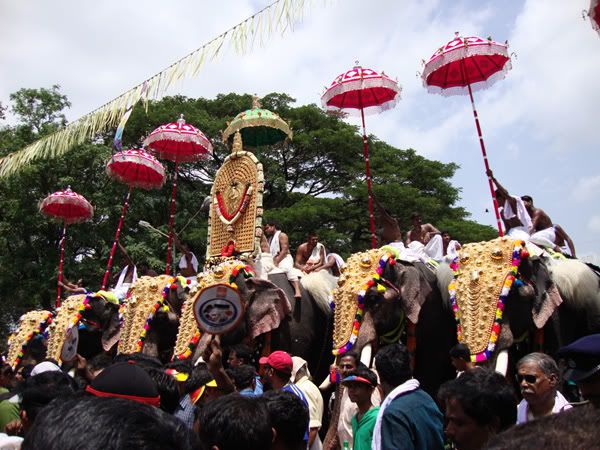
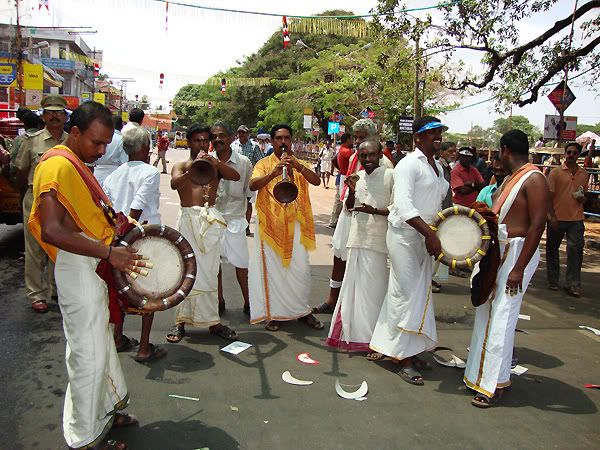
As usual, I set out to Thrissur Pooram this year too and clicked a few pics. I’m kind of losing the interest to go see Pooram during the day because of the heat and I only spent 3 hours n the town. This time it was mostly walking in the Swaraj Round and Thekkinkadu Maithaanam seeing the Pooram special sights. 🙂 Here are some pics I clicked during the stroll.


ezhunneLLippu after Madathil Varavu.


Naadawaram and Thakil vaadyam – The guy in the center (with yellow robe and moosh) has been playing in Pooram for a long time.


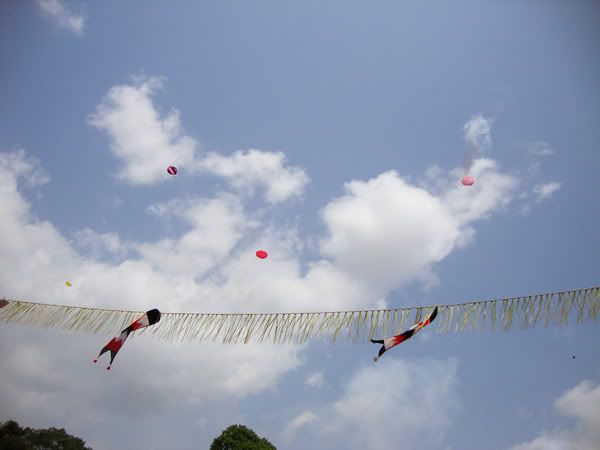
Umbrellas floating in the sky after the fireworks during the day


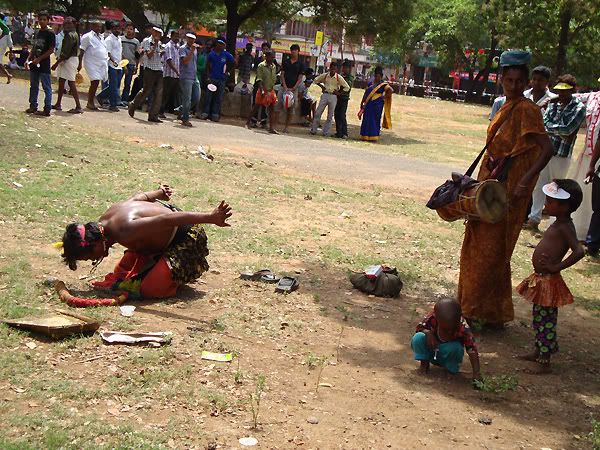
A gypsy family making a living during Pooram. Gypsy circus is a common sight of Pooram.


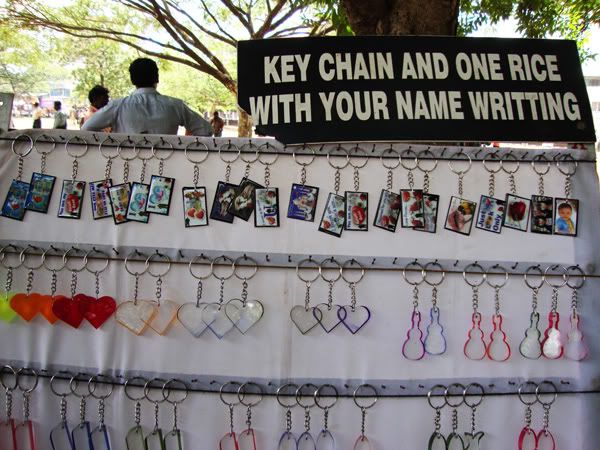
For just 20 bucks, you get a name engraved in a single rice grain which is then put up in a liquid and then made a keychain out of it!


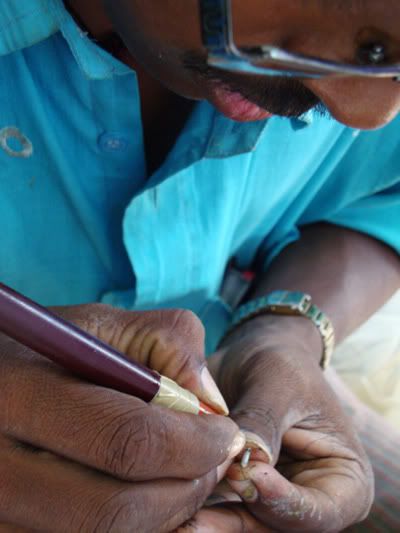
This young man is very skilled. He could write even long names on a single rice grain!


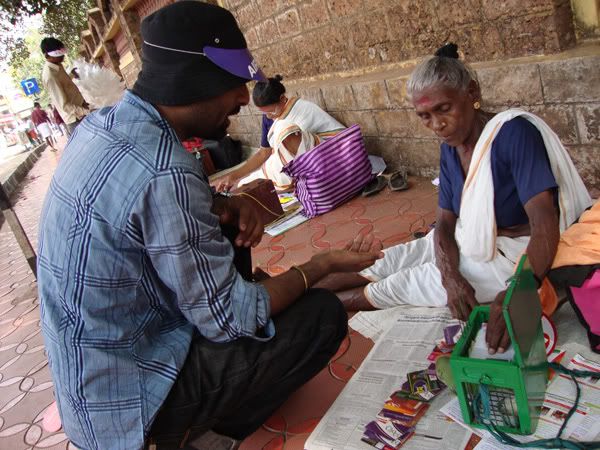
My friend Ajith sat with the card reader when I insisted. For 20 bucks, the old woman said he woud marry from the same religion and his marriage would happen soon (he is already married and it was an inter-religious marriage and he already has a kid). There is a big row of palmists and card readers outside the Nehru Park and many people go to them though they pretend it is just for fun.


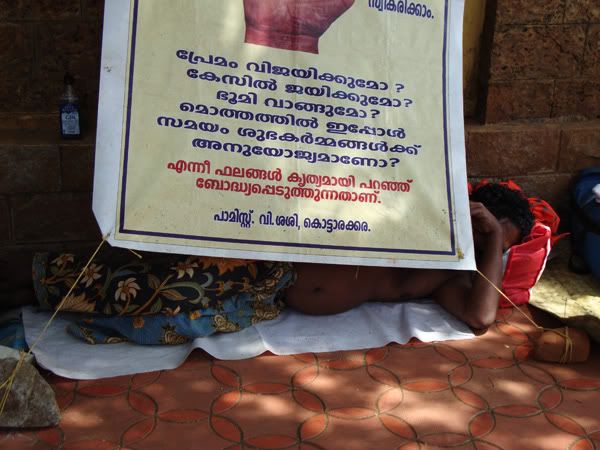
Looks like one of the palmists had his fair share of the day before noon. He is half-naked and fast asleep, must be the Gin bottle you see on the left of the banner.


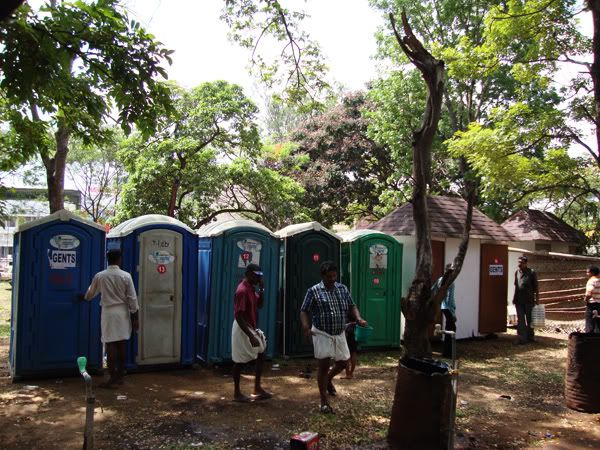
These are not phone booths, they are temporary toilets. From Thekkinkadu ground.

Mess in the name of Thrissur Pooram

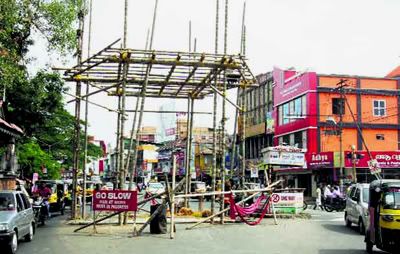
A panthal built in the center of the Swaraj Round road (image courtesy: Mathrubhumi.com)

I had written earlier about how festivals make life of the ordinary citizens living in the place a mess. There is something similar, or perhaps even more disturbing thing going on in Thrissur for years now. A part of the festival celebrations make the lives of Thrissurians a mess for almost 3 weeks an year.

Swaraj Round in Thrissur is a circular road in the center of the city and it is the busiest road in Thrissur. During Thrissur Pooram, the two participating temples would erect three huge, multi-storied panthals in this road. All three panthals are built at the center of the road, thus making the traffic blocks as long as 3-4 kilometers. It would take so much time and fuel to get you where you want to be inside the city. Not only that, even though the Thrissur corporation had left pre-defined holes for panthals in the refurbished Swaraj Round road, the panthal makers dug the road to create new holes on their own this year.

The panthal work would begin almost 2 weeks before the Pooram day and it would take 3-4 days after Thrissur pooram to remove it. This means that those who go to the city for these three weeks are really screwed. Not to mention about the plight of those who live inside the city limits. Many suggestions had been made earlier to move panthals in the large space that the Thekkinkaadu ground has or at the least to move it a little to the road side. But nothing has been done about it since this is something that involves religion and it’s customs.

This panthal mess has been going on in several parts of Kerala when there is a church or temple festival. In my parish, we used to have panthals in the road for the annual festival and there had been two accidents. Once, the panthal slanted in the heavy rains and in another year, a truck hit one side of the panthal. Since then, the panthal was moved to a corner of the church ground.

I hadn’t really bothered about this traffic until I learned driving and last week I faced the music twice when I had to pass through the city to go some place. It is high time the authorities do something about this and the public let them do it (though the authorities and police have many suggestions, they hesitate to implement it because there is much religious and community sentiments).

Photos from the last year’s Thrissur Pooram

Save the space, please

Aattukaal Ponkala - Railway station prepaid counter

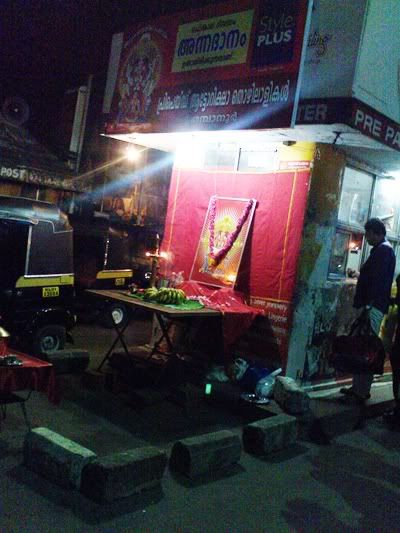
If the above photo made you think that you were looking at an offerings counter in a temple, look closer. You are looking at the prepaid auto-rickshaw counter at Trivandrum Central railway station. This photo was shot at 6 in the morning on February 14th Monday, after a tiresome night train journey. I was running towards the pre-paid counter because there would usually be a long que there if you got down from the train a bit late. The prepaid center has two ticket counters and both of them would have long ques when trains were arrived. But this Monday, I found one of them to be closed. Not just closed, they made a temple out of the place that bordered carefully with hollow bricks. So the que at one counter went on to the walk/drive ways and the traffic policemen had to control the line.

This temporary setup was made by the prepaid auto-rickshaw drivers for their Aattukaal Ponkala celebrations. They had a photo of the Goddess, a lamp lit, fruits as offerings and most of them all, a pot placed at the forefront for money offerings (which is out of the frame on the left hand side of the photo above) from the travelers. Aattukaal Ponkala was still one week away.

I don’t understand who gave them the right to use this busy public space to mint money. And how come nobody talks about it or no paper posts a photo of this, because such looting in the name of religion and such gross misuse of public space are publicly agreed upon.