The current Indian music scene

Even though the regional film music is still the favorite of the masses in India, the Indie bands are slowly and steadily finding themselves a place in the Indian and International music scene. Mother Jane, Avial, Swarathma etc are a few popular names among them. Numerous other bands and musicians are making people take a ride in the fresh musical waves. Websites like Uhooroo and Tempostand features a lot of such original artistes and their music. Many of these artistes are yet to cut their first debut album but release singles through their own websites and other music community websites including MySpace Music. You can also find amateurs or semi-professionals creating and distributing music for free through platforms like Blogswara.

The change is visible even in regional languages like Malayalam. The times when you heard only the filmy tunes have now given way to fresh sounds and I’m not referring to those crappy songs which people churn out in the name of “musical albums”, but works like Thaalam for example.

Times of India has a good article on this current music scene in India. Worth a good read.

Sam Lall, editor of Blender magazine, says one of the most encouraging signs over the past few years has been the shift away from covers. “Earlier, the measure of how good a band you were was how well you nailed Metallica. But now, it is all about original material.”

But is an Indian sound the way to go? “That has almost become a cliche. Just putting in an alaap or tabla can sound deliberate and forced. People want to listen to good rock and roll, not necessarily ethnic stuff,” says Lall. But he admits that it does help with a Western audience. “For them, there is the novelty factor.” [Are we ready to ROCK? – Times of India]

The Savita Bhabhi Saga

savita-bhabhiI came to know about Savita Bhabhi just about a month ago, when the ban on Savita Bhabhi and the announcement of the site being shut down made news in the media. I Googled for more information on Savita Bhabhi and saw that the banned contents were available in many blogs. I must admit that the graphical images of Savita Bhabhi’s sexual adventures were well enough to satisfy my single sex life. Because, if the “girl-next-door” was a symbol of teenage romance, the “aunty-next-door” was one of the many teenage sexual fantasies for us guys and Savita Bhabhi made me nostalgic all the way and fed those teenage fetish very well.

It is then I read the whole crap that was going on in the name of Savita Bhabhi. Deshmukh, owner of the website who shut down the website following the ban, said that he made the website to prove that Indian women too have sexual desires. His point was that he was contributing to the liberation of Indian women. Very cleverly said, I must say (especially after revealing the identity behind an anime porn site). I have never had a chance to browse through the original SB site (it was banned by the time I could reach there) and so I don’t know if they have had any revenue model from the website. If they indeed had a revenue model (or was planning for one), Deshmukh displayed the qualities of a modern businessman who could rationalize his commercial interests.

And then I read Pritish Nandy’s piece in Times of India, titled “The assassination of Savita Bhabhi. He see Savita Bhabhi comic as having some harmless fun spoofing the way we Indian men treat our women. He also see Savita Bhabhi as a symbol of freedom, of empowerment, of the sexuality our women can wield and of defiance against male chauvinism.

I mean, come on Mr. Nandy! Savita Bhabhi does not represent the liberation of Indian women. Her sexual adventures were mostly confined to her household. She did not dare to go for a Gigolo. She did not file for a divorce if she was unhappy with her sex life with her husband. She did not even go for a job to support herself financially. Is that whom Pritish Nandy calls a liberated Indian woman?

And is this really spoofing the way Indian men treat our women? Take the bra sales man or the domestic helper boy for example. The bra salesman has had an eye on her and Bhabhi’s seduction came as he wished. The domestic helper boy is an expert in ‘treating‘ his madams well and he too had his way with Bhabhi. The teenage boys who had sex with Savita Bhabhi said “let’s fuck her” and it almost turned out to be a rape. So is this the classic example of a free, empowered woman’s defiance against male chauvinism as Pritish Nandy calls it?

To put it simple, Savita Bhabhi had no other purpose than serving the sexual fantasies of people – men and women alike. With her graphically perfected body, she served the sexual fetish of mostly the men – old and young alike. Rest, including Pritish Nandy’s piece in Times of India, are all plain bull crap in order to rationalize their sexual fantasies (why don’t they simply admit that they liked the porn element?).

NOTE: If Pritish Nandy or any others want to read about a woman who used sexuality as a weapon to fight the oppression and an unjust social system, you don’t really need to search in the comics. Just dig a little bit into the history or read the story of Kuriyedathu Thathri in Maddy’s blog (read from paragraph # 6).

Parzania

Parzania

If you haven’t watched Parzania yet, grab a DVD copy and watch it.

  • To see the amazing performances of Naseeruddin Shah, Sarika (who also won a national award for this film) and others
  • To see what organized crime and riots do to people and their lives (the movie is based on a true story)
  • To remind yourself of sanity and humanity

Lessons from Crap

I have been watching a lot of movies lately. Many of them can give a run-for-money to those sop serial makers. But the interesting thing is that even a crappy sop movie has a message. For example,

New In Town:

The movie tells the story of a corporate consultant who came for a mass lay-off in a factory and finally finds a way to keep the heads intact.

  • Lesson #1) There is a way out of every problem even at times when you think that all the exit doors are sealed. You just need to have a will to solve it.
  • Lesson #2) You don’t need to spend 2 hours and the DVD rental (or movie ticket) money to learn what you have already learned from a proverb – Where there is a will, there is a way

Confessions of a Shopaholic:

The movie tells the story of a shopaholic journalist who finds love finally. She tries to copy something off Google for her articles and messes up at work. When she starts writing from her heart, her column becomes hugely popular.

  • Lesson) Faking yourself will not help you in anyway. Just be natural and do things in your own way – not faking someone else’s way – and success shall be yours.

PS: People who watched Mammootty’s latest “Pattanatthil Bhootham” also says that even that movie has a message – About how not to take a movie.

The Rain Orchestra

I love experimental art. For they dare to do something new, fresh and original. Here is one, called The Rain Orchestra and it’s a group of people making the sound of rain with their hands and feet. The raining begins with small drops of water, then it comes heavy with thunder etc and then finally sets off. I would recommend that you just close your eyes and listen to it first and then watch the visual. I don’t know who orchestrated it and where did this happen, so if any of you get any more info on this, please pass on.

By the way, don’t forget to put your headphones on! 🙂

(Thanks to Arun for the link)

Paala Poovithalil – Thirakkatha (cover)

Here is a song from the Malayalam movie Thirakkatha. The album marks the come back of music director Sharath to the Malayalam cinema after a break. This is a duet song and I did it myself. 🙂

Movie: Thirakkatha
Music: Sharath
Original singers: Nishad, Swetha
Covered by: Joseph Thomas (Jo)

Download MP3 of “Paala poovithalil (cover)”

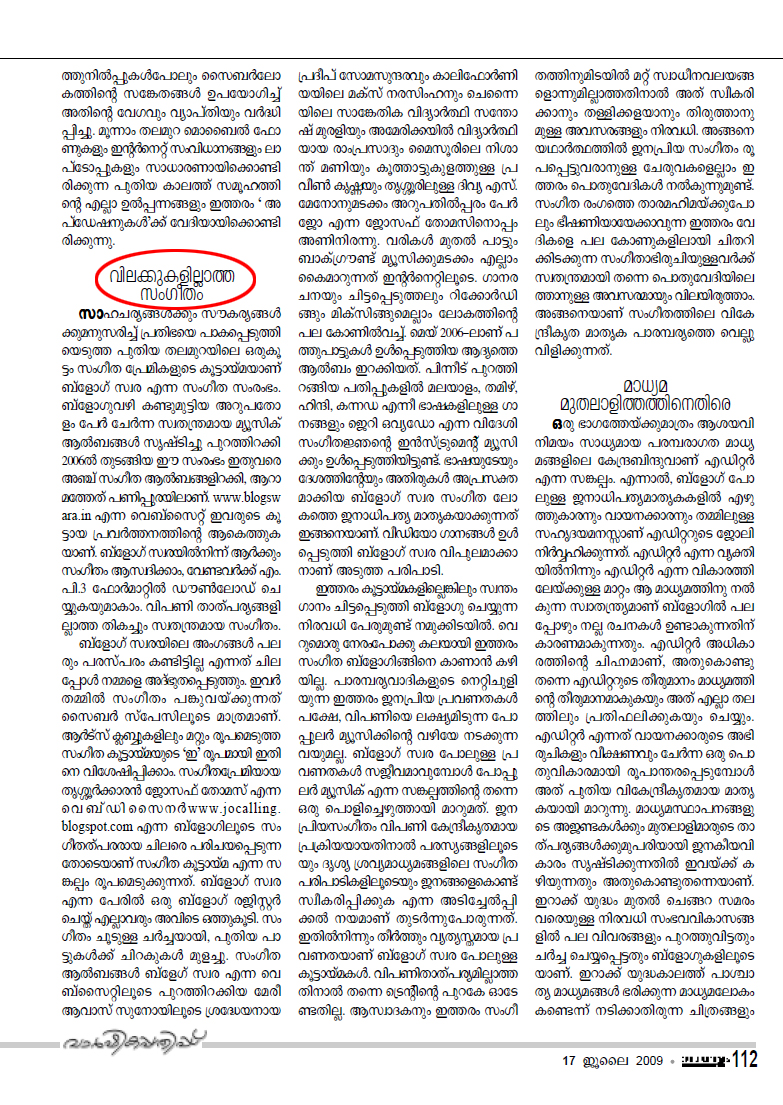
Blogswara in Malayalam Vaarika

Blogswara has been featured in this year’s annual edition of Malayalam Vaarika, a popular literary weekly in Malayalam by the Indian Express group. In an article about New Media and it’s advantages, B S Biminith has drawn out the possibilities of new media in detail. He has written about Blogswara and original music production in the blogging world. I would like to quote some of the interesting (and valid) points he made in the article. Pardon any translation errors:

There are many people among us who compose and broadcast their songs through blogs. These music blogging efforts cannot be observed as a time pass art. Such popular trends may not please the traditionalists, but it doesn’t walk in the ways of popular music that is targeted at the market. When the concepts like Blogswara become active, it will re-write the very idea of popular music.

Since the current popular music is a market-oriented process they push their music through advertisements and the music programmes in various audio and visual media. But the groups like Blogswara are totally different from this. They don’t have to run after the trends because they don’t have any commercial interests. Also there are many opportunities to accept, reject or suggest changes, as there are no other influential barriers existing between the audience and musicians. In that way, such public platforms provide all the ingredients to form the real popular music. We can also observe that such platforms, which could become a threat to the stardom of the current music scene, as a chance for people from around the world who have musical interests to step to the public on their own. That is how this decentralized model of music challenges the traditionalism.

For those who can read Malayalam, click on the image below to read a portion of the article:

Malayalam Vaarika - Annual Edition